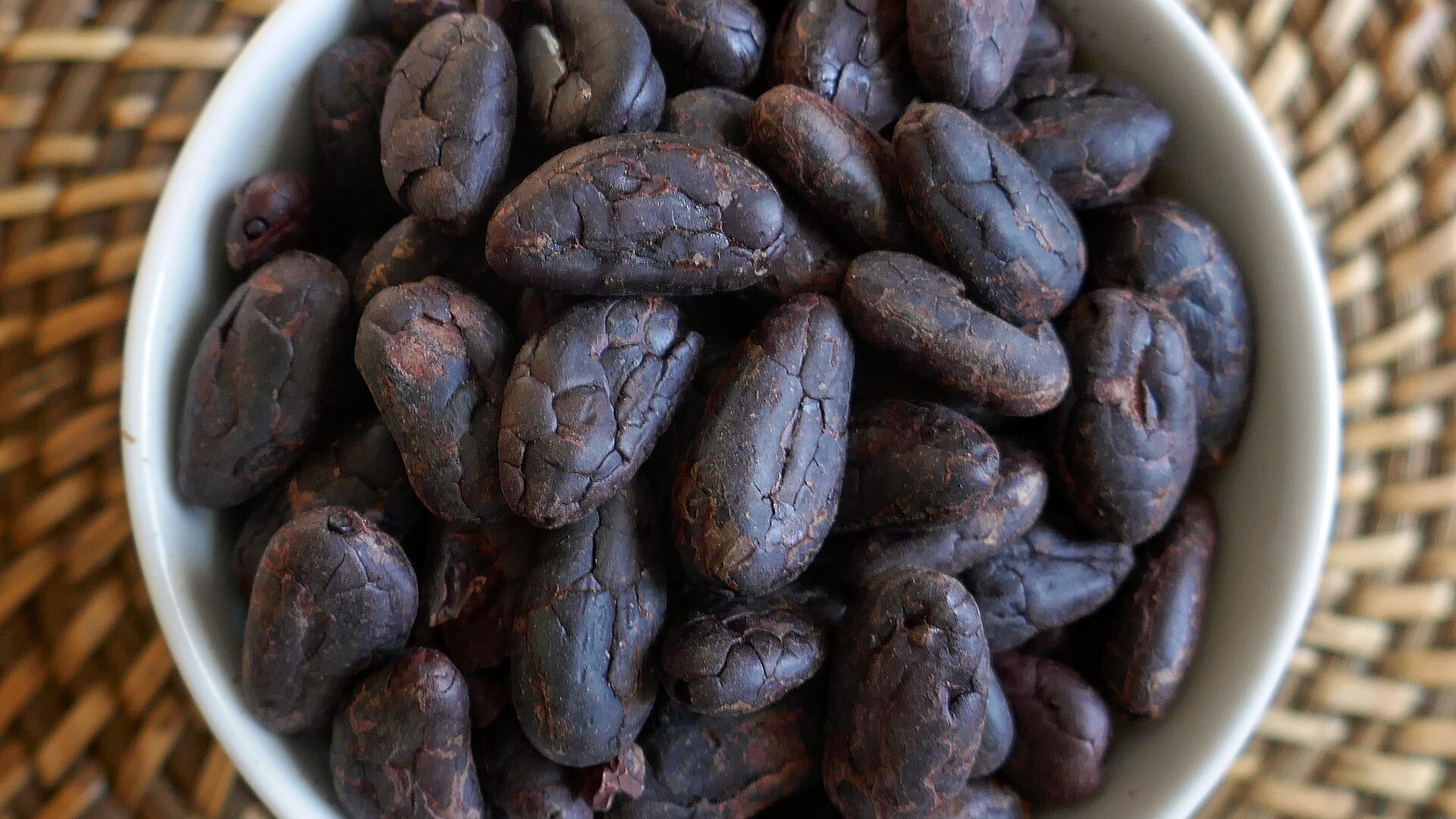
Bean to bar is seven real stages, and depending how you count the drying and conching time, anywhere from about two weeks to well over a month from a fermenting box to a finished, tempered bar. The interactive timeline on the home page lets you explore each stage’s real duration and what’s physically changing in the cacao; the list below is the same seven stages as reference reading.
-
01
Fermentation 2–9 days
Beans and surrounding pulp are piled in boxes or heaps, where wild yeasts and bacteria convert the pulp sugars into acids (mainly lactic and acetic) and heat the pile to as high as 45-50°C. That heat and acidity kills the bean and triggers the breakdown of bitter polyphenols and storage proteins into the amino acids and reducing sugars that become chocolate flavor once roasted — skip or rush this stage and no amount of roasting later can create real chocolate flavor from scratch.
-
02
Drying 5–14 days
Fermented beans are spread on raised mats or drying tables in the sun (or in mechanical dryers where weather is unreliable) until their moisture content drops from roughly 60% to 6-8%. Drying halts fermentation at the right point, prevents mold during storage and shipping, and lets the acetic acid built up during fermentation continue to evaporate off the bean.
-
03
Roasting 15–35 minutes at 120–150°C
Whole beans (or, in some craft processes, nibs after winnowing) are roasted far more gently than coffee — typically 120-150°C versus coffee's 200-230°C — because the flavor precursors were already built during fermentation. Roasting here finishes drying the bean, loosens the shell for winnowing, and drives a comparatively light Maillard reaction between those fermentation-built amino acids and sugars to develop the final "chocolate" flavor notes.
-
04
Winnowing Minutes — a mechanical separation step
Roasted beans are cracked and passed through a winnower, which uses a stream of air to blow away the lightweight, papery shell while the denser nib — the part that actually becomes chocolate — falls through. Shell left in the nib tastes bitter and gritty, so craft winnowers aim for well under 1% shell content by weight in the finished nibs.
-
05
Grinding & conching 4–78 hours (varies widely by desired quality)
Nibs are ground — traditionally in a stone melangeur — into cocoa mass, then conched: continuously worked and aerated, with sugar (and milk solids, for milk chocolate) added along the way. Conching reduces particle size below roughly 20 microns, the point at which the tongue stops perceiving individual particles as gritty, and drives off residual volatile acids for a rounder flavor. A quick commodity conche can run a few hours; the most demanding craft and couverture houses still conche for up to three days.
-
06
Tempering 20–45 minutes per batch
The finished chocolate is carried through the melt/cool-seed/work temperature curve (see the tempering visualizer above) to grow stable Form V cocoa-butter crystals throughout the batch — the difference between a bar that snaps cleanly and one that turns dull and streaky within days.
-
07
Molding 10–20 minutes to set, up to 24 hours to fully stabilize
Tempered chocolate is deposited into molds (or bar frames, for couverture blocks), vibrated to release trapped air bubbles, and cooled in a temperature-controlled tunnel or room. Bars are firm enough to demold within 10-20 minutes, but the crystal structure keeps stabilizing for up to a day before the bar reaches its final snap and gloss.
Why we don’t rush conching
Conching is the stage most craft chocolate makers compress the most under cost pressure, and it’s also the stage that decides whether a bar tastes rounded and smooth or thin and acidic. We run our conche long enough to get particle size down where the tongue stops perceiving grit and to drive off enough residual acetic acid for the origin’s real flavor to come through clean — not to a fixed clock.
Tempering, every batch
See the tempering curve visualizer on the home page for the real melt/cool-seed/work temperature curve we run for dark, milk, and white chocolate — the difference between a bar that snaps cleanly on release day and one that turns dull and streaky in a customer’s pantry within a week.